A member cares about an ongoing rostering problem. They complain to a colleague, raise it with the company, follow a discussion in a Facebook group, and wonder what the association is doing about it. Meanwhile, the association is working on the same problem and wishes more members would submit reports. Both sides have what the other needs. Yet getting that information from one to the other can still be surprisingly difficult.
It’s tempting to call this a lack of engagement. But before we conclude members aren’t interested, consider how much effort we expect from them. Read the email. Find the survey. Remember where to submit a report. Or was that supposed to go by email? Eventually, they end up in that WhatsApp group the association avoids because it’s too “noisy.” We know from our own behavior how easily a small task becomes something we’ll do later. Why would our members be any different?
Follow one rostering issue
Consider an association whose rostering committee is dealing with a recurring problem. The committee has heard from some members, has a reasonable understanding of what is happening, and is discussing it with the airline. Its work is underway.
The association also has a reporting module in 2Way, with a template it has set up specifically for rostering issues. Members have a structured way to report what happened, without having to determine whom to email or what to include. They can even prepare a report offline when a connection isn’t available.
That is useful, but having the reporting tool available doesn’t ensure members will remember to use it. If they rarely visit the platform, the committee may still hear from the same small group, while other members discuss their experiences elsewhere.
Now, the committee publishes a brief update. Here’s the issue we’re working on, what we’ve raised with the airline, and what we still need to understand. There doesn’t have to be a final result to announce. The work itself gives members something relevant to read.
One source, several ways in
Some members notice the update in the app. Others receive a link by email. Someone discussing the issue in a Facebook group shares a direct link. The committee can point members to the update instead of saying, “It’s somewhere in the app.”
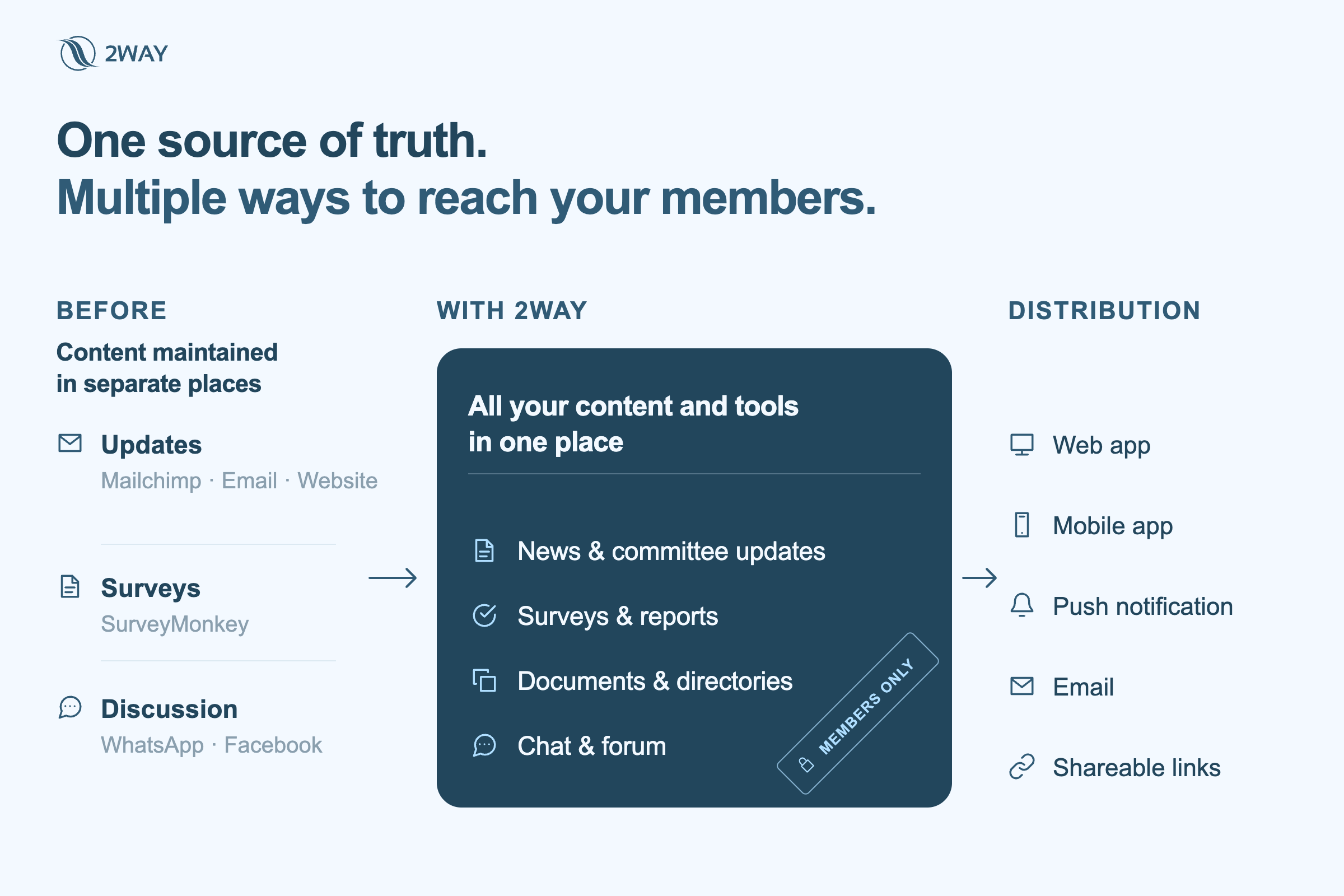
This is where a single source of truth matters. It gives the association one official place to maintain information, with several ways to reach people. Sharing a link in a group doesn’t mean maintaining another version of the update there.
When members arrive, the update sits alongside the reporting tool, committee news, surveys, and discussions. Someone who comes to see what the committee is doing may realize that their own experience would be useful and submit a rostering report. Another member may discover the reporting feature while reading something else entirely. The committee receives more input because members spend more time in places where they can actually contribute.
This is where it starts to build
More reports can give the committee a clearer picture of members’ experiences and more specific information for its discussions with the airline. The committee then has something useful to share in its next update: what members have reported, what it is following up on, and what remains unresolved.
Members see the work continuing. They have a reason to return and another opportunity to contribute while they are there. Nobody needs to become a committee member or join every discussion. A short report on something that happened on duty can be enough. More useful updates bring members back, more visits create opportunities for reports, and those reports help the committee with its work.
Imagine a creator building a YouTube channel. If each video were posted to a brand-new account, it would have to attract an audience from scratch. Keeping the videos together lets someone who finds one discover the others, so earlier work continues to provide value.
An association’s platform can be built in a similar way. A rostering update brings someone in, but there is more to the platform than the one item that caught their attention. Over time, useful content and familiar tools give members more reasons to visit and fewer obstacles when they have something to contribute.
That’s what we’re trying to make easier with 2Way. Publish the work in one place, reach members through the channels they use, and make it easy for them to respond. The committee’s next useful report may come from a member who only stopped by to read an update.