Introduction
For many association leaders, “modernizing communication” sounds like extra work dressed up as progress.
One more tool means one more login, one more process, and one more inbox to monitor. For organizations already stretched across staff and volunteers, this feels risky.
But the root issue is usually not modernization itself. The root issue is fragmented workflow.
When updates, documents, forms, and follow-up actions are spread across separate systems, every important message creates additional coordination work. Teams are not just publishing updates. They are chasing handoffs.
The Admin Burden Is Usually a Workflow Problem
In most member-led organizations, communication work continues long after an announcement is sent.
Members need to:
- find the right document,
- complete the right survey,
- submit the right report,
- respond in the right place.
If each step lives in a different location, admins spend time directing traffic instead of moving initiatives forward.
That is why teams can be highly active and still feel overloaded. The workload comes from stitching together fragmented steps, reconciling conflicting versions, and answering avoidable “where do I do this?” questions.
A Common Breakdown Sequence
Take a typical policy-update workflow:
- Leadership approves a policy change.
- Operations shares the official update by email.
- Supporting documents are stored in a separate drive link.
- Member feedback is requested through a different form tool.
- Committee follow-up happens in local chat threads.
Every step is reasonable on its own. Together, they create admin drag:
- repeated reminders,
- duplicate clarifications,
- unclear ownership of follow-up,
- weak visibility into who completed what.
When this repeats across events, training updates, and safety reporting, communication overhead becomes structural.
Why “More Channels” Is Not Modernization
Associations often add channels to solve urgency. But adding channels without workflow design often amplifies complexity.
Modernization should not be measured by how many tools you adopt. It should be measured by whether day-to-day communication work becomes simpler and more reliable for admins, clearer for members, and more visible for leadership.
A modern communication model should provide:
- one clear official source path,
- fewer manual relay steps,
- explicit ownership for each phase,
- better visibility into engagement and follow-through.
This is how organizations reduce both confusion and rework.
What Better Looks Like in Practice
A practical modernization approach for pilot associations and similar member organizations starts with one high-impact workflow, not a full system overhaul.
Map a single recurring flow end-to-end, such as event changes, policy updates, or required member actions. Identify where handoffs are manual, where official information is unclear, and where completion data disappears.
Then simplify:
- centralize where official information lives,
- reduce the number of repost points,
- align response and reporting paths,
- define who owns each communication stage.
The immediate benefit is lower admin burden. The longer-term benefit is higher confidence that communication is understood and acted on.
Where 2Way Fits
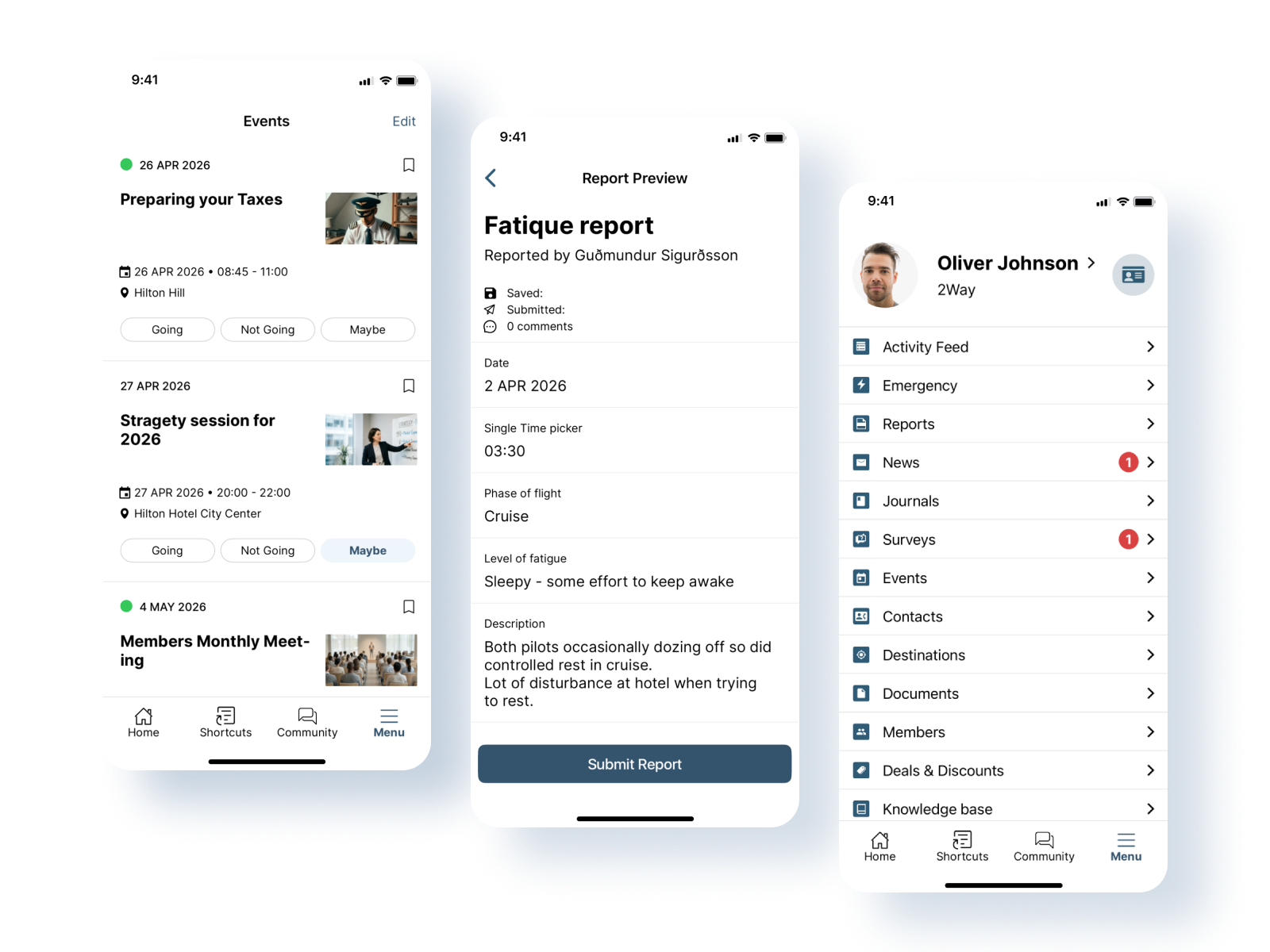
2Way is relevant when associations want to simplify communication without losing role-specific context.
Its value is not “one more channel.” Its value is coordinating communication flow across leadership, operations, committees, and members so official information is easier to publish, easier to find, and easier to manage.
That helps:
- leadership improve visibility,
- operations reduce manual coordination work,
- members navigate updates with less friction.
Conclusion
If communication modernization creates more admin work, the workflow is still fragmented.
The right target is not channel expansion. The right target is coordination clarity: clear ownership, fewer handoffs, and one reliable path for official communication and follow-through.
Modernization should feel lighter over time. If it does not, the system design still needs work.