Most aviation associations are not short on structure.
They have a board. They have people responsible for specific areas. They have committees and groups that understand their own part of the operation.
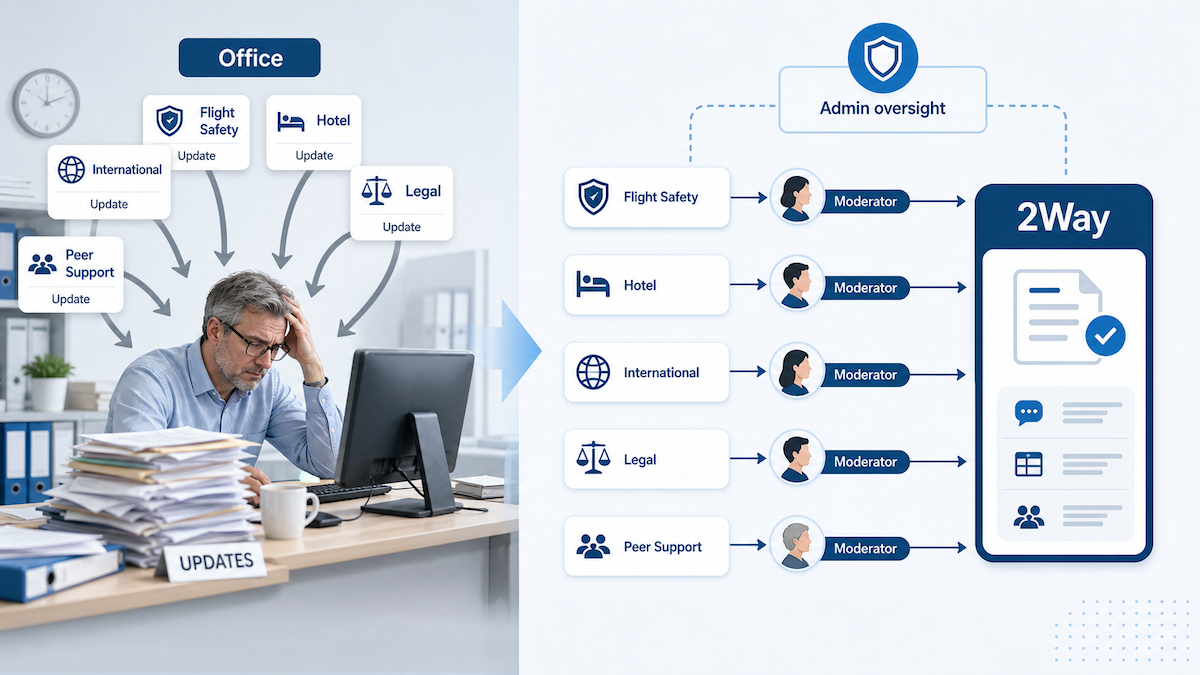
The Flight Safety Committee understands safety communication. The Hotel Committee knows what needs to be said about accommodation issues. The International Committee follows international matters. The Legal group handles sensitive legal updates. The Pilot Peer Support Group understands support information that may need to reach members carefully.
On paper, responsibility is already distributed.
But in practice, communication often is not.
A group prepares an update. Someone knows exactly what needs to be said. The information is relevant to members. And still, the update ends up going through the same office queue before it reaches the people who need it.
Not because the office is doing anything wrong.
Usually the opposite is true. The office is often carrying too much because that is the routine everyone has got used to.
That is the mismatch: responsibility is distributed, but publishing rights and communication workflows often are not.
The Problem Is Not The Association Structure
Committees and specialist groups exist for a reason.
They keep knowledge close to the people who understand the subject. A Flight Safety Committee should not need to explain every detail of a safety update to someone else before members can receive it. A Hotel Committee should not have to push every accommodation update through the same overloaded person. A Pilot Peer Support Group may need to share information carefully, with the right audience and the right level of control.
The structure already exists.
The problem starts when the communication workflow does not match it.
Instead of each approved group managing its own part of the communication inside the official platform, the work is passed back to one office or admin person. That person may already be handling member questions, documents, reports, events, updates, app content, board requests, and routine office work.
One update is manageable.
Ten updates from different parts of the association become a bottleneck.
Over time, the association builds a habit that works against its own structure. The right people may know what needs to be said, but the publishing route is still too narrow.
What This Costs In Practice
The cost is not always obvious.
It often shows up as small delays, repeated handoffs, and unclear ownership.
A committee or group has an update ready, but it waits until someone in the office has time to publish it.
Members ask about information before it has gone out.
The office has to clarify, reformat, schedule, target, or resend updates that another group already understood well enough to communicate.
Leadership may see a communication delay and assume the issue is lack of activity. In reality, the issue may be that too much activity is being forced through one route.
The practical cost is workload concentration.
A few people become responsible for moving information from every part of the association to every relevant member group. That creates delay, reduces ownership, and makes the official communication process more fragile than it needs to be.
The Answer Is Not Everyone Posting Everything
This is where associations need to be careful.
Distributed publishing does not mean uncontrolled publishing.
It does not mean every member can post official updates. It does not mean every committee or group can communicate with every audience. It does not mean removing oversight from the office, admin team, or leadership. That would create a different problem, the better model is controlled delegation.
The right people should be able to manage their own part of the communication, inside one official platform, with permissions and oversight still in place.
The Flight Safety Committee should be able to publish a safety update.
The Hotel Committee should be able to update members about relevant hotel or accommodation matters.
The International Committee should be able to share international updates with the right audience.
The Pilot Peer Support Group should be able to share support information in a way that is visible, official, and appropriately limited.
The association should still control who can publish, where they can publish, and which audience they can reach.
That is the difference between opening the door to noise and building a working communication structure.
Where 2Way Fits
2Way was built around this kind of association reality.
It is not only a place where members receive official information. It also helps the association organize who is allowed to communicate, to which audience, and inside which official structure.
Through moderator roles and permissions, approved committee or group leads can manage updates for their own area.
Admins keep control over access, audiences, and oversight. Members still receive information in one official association platform.
The point is not to create more channels.
The point is to stop forcing every official update through one overloaded person when the association already has trusted people responsible for those areas.
What Each Role Gains
For the office or admin team, controlled delegation can reduce the number of updates that need to be manually moved from one person to another. The office still keeps oversight, but it does not need to become the publishing desk for every part of the association.
For committee and group leads, it creates clearer ownership. If the Flight Safety Committee owns the safety topic, it can also own the safety update inside the official platform, within the rules set by the association.
For leadership, it creates a clearer structure. It becomes easier to see which part of the association is responsible for which communication area, instead of everything appearing as one long office queue.
For members, it reduces uncertainty. They receive updates inside the official platform and can see that the information comes from the right part of the association.
None of this requires the association to lose control.
It requires the association to make its communication workflow reflect the structure it already has.
A Simple Way To Review Your Current Workflow
Start with one recurring update type. For example, choose one update from the Flight Safety Committee, Hotel Committee, International Committee, Legal group, or Pilot Peer Support Group.
Then ask:
- Who creates this update?
- Who understands the topic best?
- Who currently publishes it?
- Which members need to receive it?
- Where does delay usually happen?
- What permissions and oversight does the association still need?
If the same office person is carrying the final publishing step every time, the workflow may not match the association’s own structure. That does not mean the office should step away. It means the office should not have to carry every communication step that another approved group can manage safely.
The Real Shift
The real shift is not technical. It is operational.
Associations already distribute responsibility through committees and groups. The communication workflow should support that structure instead of pulling everything back into one office queue.
For the office team, this can reduce unnecessary handoffs. For committee and group leads, it can increase ownership. For members, it can make updates more timely and easier to trust.
For leadership, it can create clearer official communication without losing control. This is the balance associations should aim for:
not everyone posting everything, not one person carrying everything, but the right people managing their part of the communication in one official place.
Practical Next Step
- Pick one group that regularly sends updates through the office.
- Map the current path from draft to member delivery.
- Then ask whether that same update could be handled through a controlled moderator role inside the official platform, with admin permissions and oversight still in place.
- If the answer is yes, that is a practical first workflow to improve.
That is the kind of structure 2Way is designed to support.