A safety notice goes out to members on Monday morning.
By Monday afternoon, a correction is needed.
Committee representatives discuss the change in chat. A revised PDF is uploaded to the portal. Members start asking which version now applies.
Leadership can confirm one thing: the message was sent.
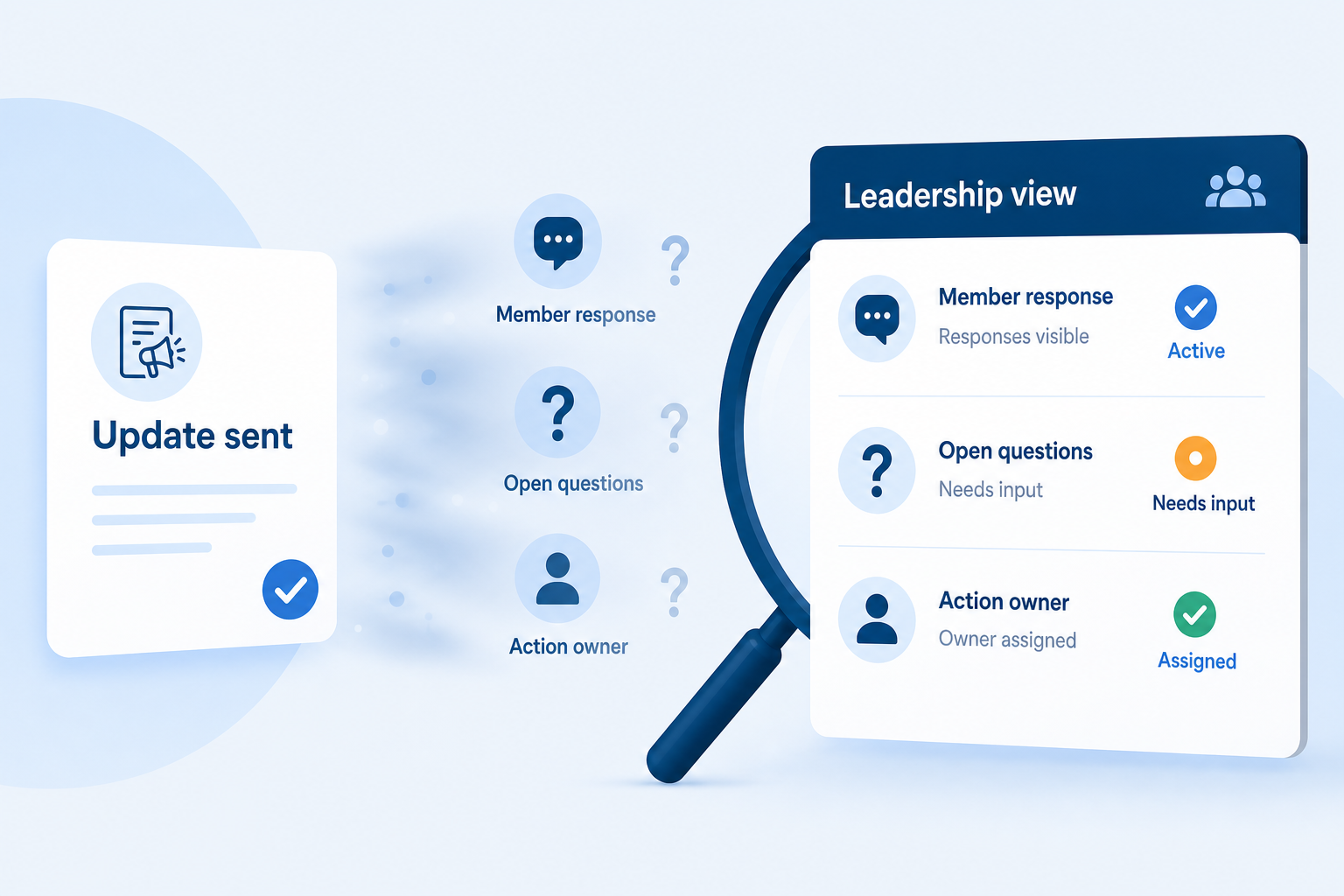
What leadership still cannot see clearly is what happened after send.
That is where the board-level questions begin:
- Which version did members actually receive?
- Did members acknowledge or respond?
- Where did concerns appear?
- What still needs action?
When leadership cannot answer those questions quickly, communication is incomplete from a governance perspective.
The Gap Between “Message Sent” and Leadership Visibility
Sending an official update is a delivery event.
Leadership needs more than delivery confirmation. It needs post-send visibility that is board-ready and reliable.
That means seeing whether communication held its integrity from first publish to final follow-through, not just whether the first message left the system.
What Gets Lost Across Fragmented Channels
Aviation associations usually run communication through multiple useful tools: email, chat groups, portals, PDFs, and spreadsheets. The issue is not that any one tool exists. The issue is what gets lost when official flow is split across them.
Common losses include:
- version control after revisions;
- member acknowledgement or response clarity;
- committee feedback context tied to official wording;
- unresolved questions that stay in side channels;
- manual summaries stitched together for leadership;
- unclear action ownership after follow-up.
These losses create a reporting lag between what happened in the field and what leadership can confidently act on.
This Is Not About Tracking Everything
Leadership does not need to monitor every minor message.
Start where communication risk is highest:
- official wording changes after first publish;
- members must take action based on the update;
- board or leadership follow-up depends on clear status.
In these workflows, leadership needs follow-through visibility, not channel-by-channel noise.
Why This Matters for Board-Level Decisions
This is not only an operations inconvenience. It affects leadership quality directly:
- governance confidence drops when status evidence is fragmented;
- trust weakens when members and committees see conflicting instruction states;
- decisions slow down because leaders need manual clarification first;
- accountability blurs when action ownership is distributed across channels;
- admin and representative updates become the only way leadership can reconstruct status.
Most boards do not need perfect certainty. They need reliable status to make defensible decisions on time.
The 2Way Angle: Official Flow Plus Visible Follow-Through
2Way is relevant when an association needs one controlled loop from official update to leadership action visibility.
That loop includes:
- an official communication flow with clear source ownership;
- member response linked to the official update;
- controlled discussion tied to the same context;
- reporting and visibility across update, response, and follow-up;
- a shared admin/leadership view of what still needs action.
The goal is not to remove every existing channel on day one. The goal is to make high-risk workflows decision-visible instead of manually reconstructed.
What Leadership Should Ask Before Buying Another Communication Tool
Before adding another communication product, leadership should ask:
- After an update is revised, where is the official current version visible?
- Where can we see member acknowledgement or response by role?
- How are committee concerns linked to the official update context?
- Which unresolved questions are still open, and who owns each one?
- How much manual summary work is required before board review?
- Can leadership see what needs action without waiting for ad hoc reconciling?
If those answers depend on manual stitching across tools, the issue is not message volume. The issue is whether leadership can see the full path from update to response to action.
A Practical Next Step
Choose one high-risk workflow such as a safety notice revision, fatigue protocol update, or training deadline change.
Map it from first publish to final action and ask one board-level question:
After the update is sent, what can leadership actually see?
That question usually reveals whether the current stack is enough or whether the association needs a controlled official communication and visibility model.