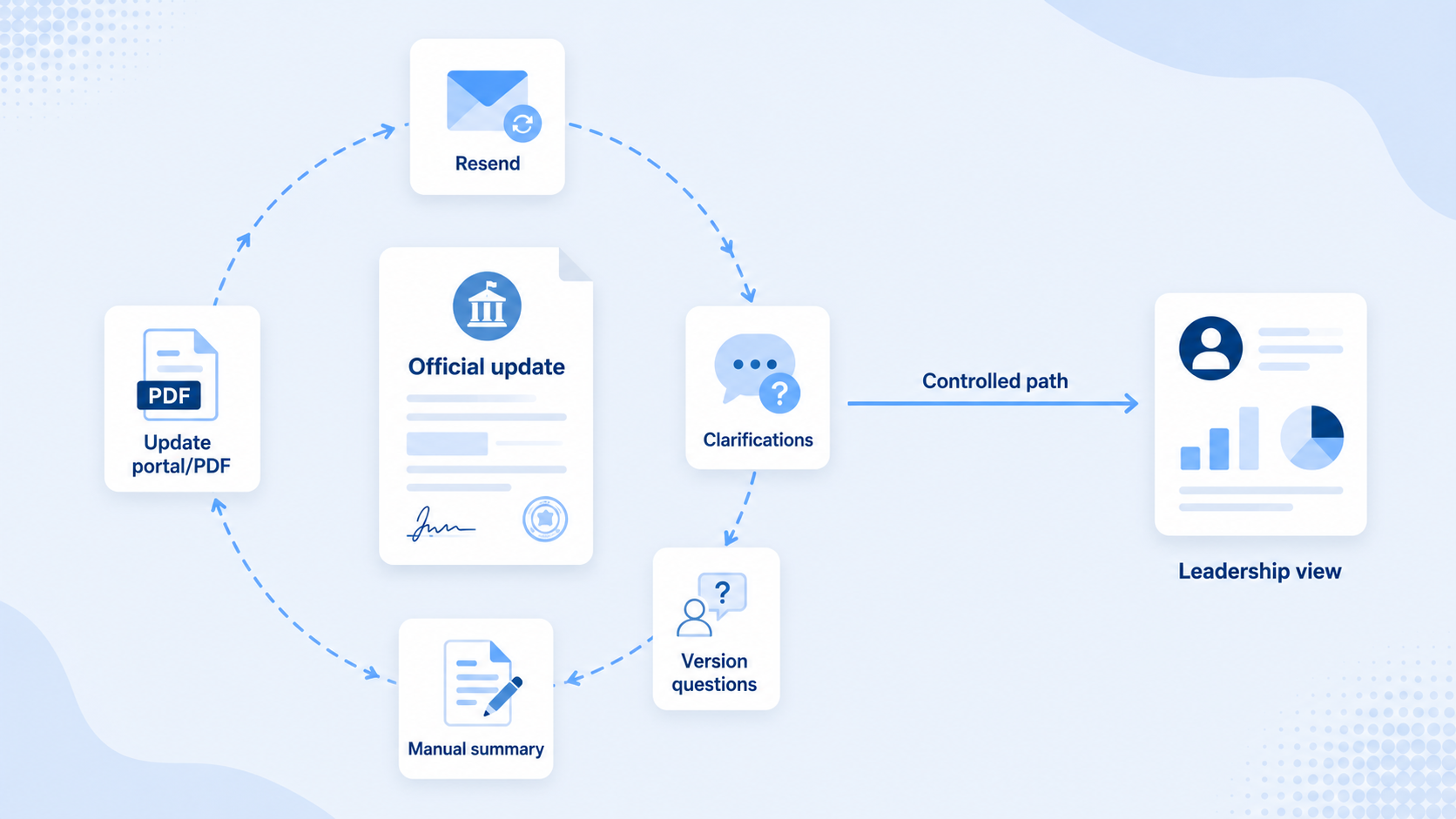
A training deadline update goes out to members.
After operational input, the deadline wording is corrected.
A committee chat clarification appears first. Then a revised PDF or portal page is posted. Members start asking, “Which version is current?”
That sequence is a correction loop: one official update that must be re-explained across channels before members and leadership can trust the final instruction state.
Correction loops add significant extra work, even when every team involved is acting in good faith.
Most aviation associations do not see that cost on a budget line. They see it in admin workload, repeated member clarification, and delayed leadership visibility after updates change.
Who This Problem Hits First
Primary buyer role: general secretary, admin lead, or communications lead.
Secondary stakeholder: president/chair and board members who depend on reliable communication status before decisions.
If your team has to answer “which version is current?” across email, chat groups, PDFs, and portal pages, you are already paying correction-loop cost.
What a Correction Loop Actually Includes
Correction loops are not one extra email.
They are a chain of tasks:
- resend official updates after a wording change,
- post clarifications in committee chat groups,
- update portal or PDF versions,
- answer repeated version-check questions,
- manually reconcile who received and acted on the latest instruction.
Each step looks small in isolation. Combined, they consume real capacity.
The Hidden Cost Map
| Cost area | What happens in practice | Business consequence | Proof status |
|---|---|---|---|
| Admin rework | Teams resend and restate updates after revisions across channels | Capacity drain and slower execution of other priorities | Directional |
| Member clarification | Members ask for current-version confirmation after conflicting notices | More clarification effort and slower member response | Directional |
| Wording drift | Local relay channels reinterpret revised official wording | Inconsistent execution and more follow-up correction work | Directional |
| Leadership delay | Status is stitched manually from multiple tools | Slower board-ready visibility and weaker decision confidence | Directional |
This is why teams can feel busy all week while still lacking communication confidence.
One Aviation Workflow Example
Take a training requirement deadline change:
- Admin/comms sends the first official deadline update by email.
- A revision is needed after operational input.
- Committee reps relay a correction in chat.
- A revised PDF or portal page is posted.
- Members reference different versions.
- Support and admin/comms reconcile the confusion manually.
The communication did happen. The control did not.
Why This Is a Buying Conversation, Not Just an Internal Process Issue
Correction loops create urgency when they affect high-risk updates and repeat often.
Signals that this is now a buying-priority problem:
- repeated re-sends after update changes,
- repeated “which version is official?” inquiries,
- board requests for communication accountability that require manual compilation,
- admin/comms teams reporting ongoing reconciliation burden.
If those signals are present, the cost is already visible in admin capacity, member clarity, and leadership visibility.
What Not To Fix First
Low-risk announcements may not need workflow redesign first.
Start with workflows where:
- wording changes after first send,
- members must take action,
- questions repeat across channels,
- leadership needs clear status,
- admin rework is clearly recurring.
Objection: “Migration Adds More Work Than It Removes”
This objection is valid.
A practical response is not full replacement. It is phased control:
- Keep useful channels for low-risk communication.
- Select one high-risk workflow where correction loops recur.
- Define one official member-only source path for that workflow.
- Tie response and controlled discussion to that same official path.
- Give admin and leadership one visible follow-through view.
This reduces republishing handoffs first, before broader change.
Where 2Way Fits
2Way helps aviation associations close the loop between:
- official publishing,
- member response,
- controlled discussion,
- leadership/admin visibility.
In correction-loop terms, the goal is straightforward: fewer cross-channel corrections, less manual status stitching, and clearer official follow-through.
A 20-Minute Correction-Loop Audit
Run this on one real workflow from the last 30 days.
Document:
- Where the first official version was published.
- Where revisions were introduced.
- Which channels carried clarifications.
- How members confirmed the final instruction.
- How leadership received status.
If these answers require searching across multiple tools and people, correction-loop cost is likely high enough to justify workflow redesign.
Next Step
Pick one workflow with repeated corrections (for example, training deadline updates, fatigue reporting protocol changes, or event-change notices).
Map current state versus controlled official flow with the roles involved.
Book a workflow mapping call with 2Way to map one correction loop and leave with a practical first-step plan your team can run immediately.
Contact us!