Aviation associations rarely have a sending problem.
They have a control problem.
Most teams already use email, committee chat groups, portals, PDFs, survey tools, and spreadsheets. Yet members still ask, “Which version is official?” Admin teams still run correction loops. Leadership still waits for manual summaries before decisions.
The issue is not tool count. The issue is what happens between tools when an update changes and people need to act.
The Real Failure Pattern: Useful Tools, Broken Official Flow
Each channel in the current stack solves a real local need:
- Email reaches everyone quickly.
- Chat groups move fast in local committees.
- Portals and PDFs preserve records.
- Surveys collect structured feedback.
None of that is wrong.
The breakdown happens when official communication, response, and follow-through are split across those systems without clear ownership from first update to final action. That is where critical updates get missed, misread, or delayed in practice.
Why the Workaround Stack Persists
Associations keep this stack for rational reasons:
- Each tool solves one local problem quickly.
- Committees and regional reps need communication speed.
- Existing portal/PDF workflows feel governance-safe for records.
- Teams optimize for immediate delivery, then patch consistency later.
The stack persists because local utility is real. The failure is at the system level.
Alternative-by-Alternative Reality
| Alternative | What it does well | Where it breaks down for official communication | What 2Way adds without dismissing the tool |
|---|---|---|---|
| Email/newsletters | Broad and fast distribution | Revised versions and follow-through visibility are hard to control | Keep email for awareness, but anchor official version and response visibility in one member-only flow |
| WhatsApp/informal chat | Fast local relay | Wording drift and weak official audit trail | Preserve speed while linking discussion and action back to official wording |
| Facebook groups | Familiar channel for informal member awareness and discussion | Not ideal as the sole channel for official instructions, member action tracking, or leadership reporting | Keep as an optional awareness lane while anchoring official instructions and follow-through in one controlled source |
| Existing member portal | Archive and document access control | Archive is separate from live communication-response-decision loop | Coexist with portal records while running official operational flow in one place |
| Survey tools | Structured one-off feedback | Feedback sits outside official update context and follow-through | Tie responses to official updates and leadership action visibility |
| PDFs/shared drives | Formal downloadable records | Stale-attachment confusion after updates | Keep formal documents, but route action through one current official instruction path |
| Spreadsheets/manual tracking | Flexible local tracking | Reconciliation burden grows and delays leadership clarity | Reduce manual stitching with visible communication status and follow-up pathways |
This is why “we already have tools” and “we still miss critical updates” can both be true at the same time.
Not Every Split Channel Is a Buying Problem
Some low-risk announcements can stay fragmented without creating serious downside.
Buying urgency appears when updates:
- change after first publish,
- require member action,
- trigger follow-up questions,
- need leadership visibility on what was received and acted on.
That is the line between a manageable communication mix and a costly reliability gap.
One Aviation Example: Fatigue Reporting Protocol Update
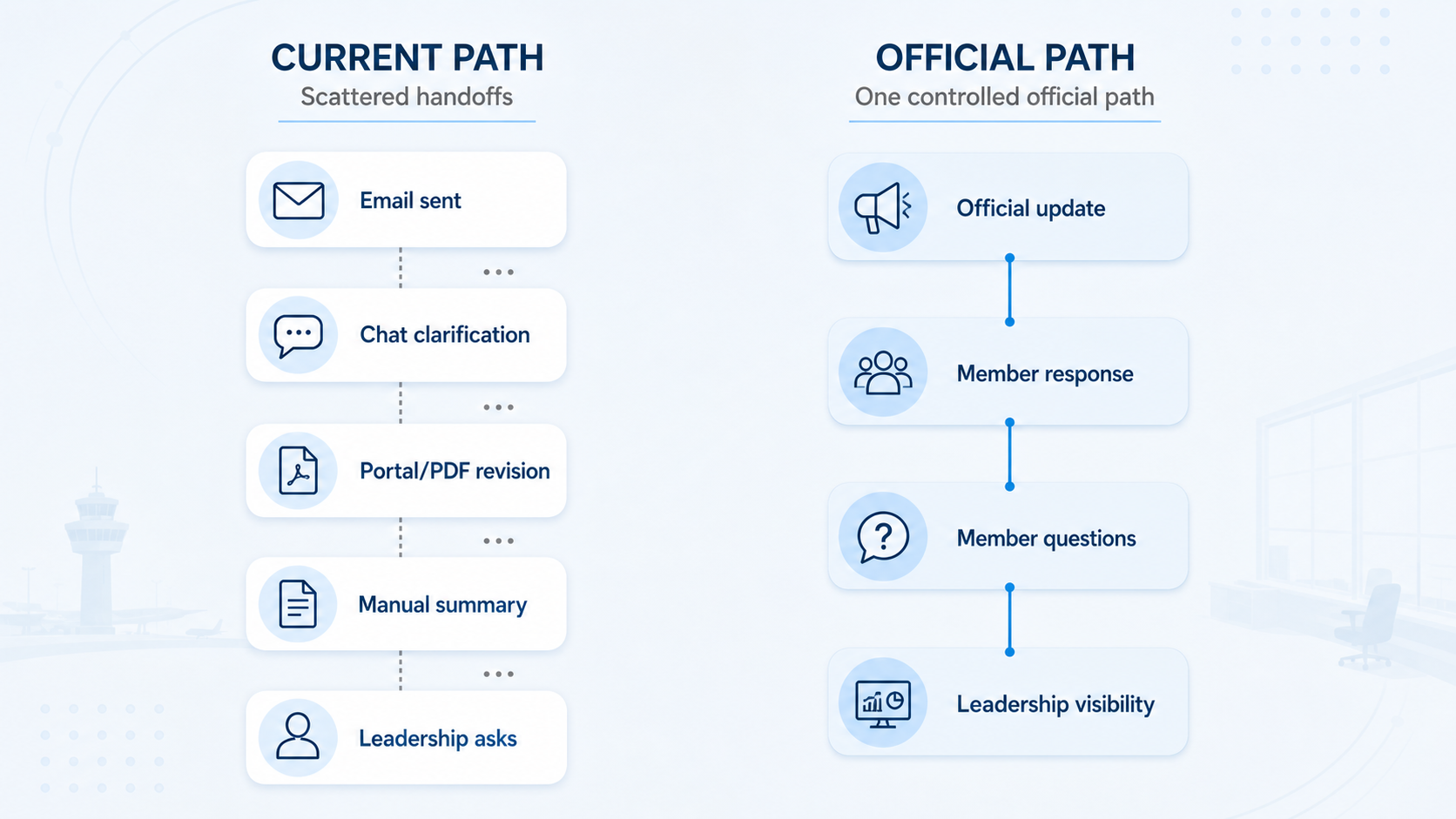
A common sequence looks like this:
- Central admin sends an official fatigue reporting protocol update by email.
- A correction is needed after first distribution.
- Clarification is relayed in committee chat.
- A revised document is uploaded to the portal.
- Member questions arrive in side channels.
- Admin and support teams manually reconcile who saw what.
The risk is not theoretical. Members can act on stale instructions while leadership assumes the latest version is already understood.
When this pattern repeats, associations pay in three places:
- Member confidence drops because “official” feels inconsistent.
- Admin workload rises through repeated clarification and resends.
- Leadership visibility weakens because status reporting becomes manual and delayed.
Why This Becomes a Governance Problem, Not Just a Comms Problem
For aviation associations, many updates directly affect day-to-day operations: safety notices, fatigue workflows, training deadlines, duty-limit interpretation, and event changes.
If official wording drifts across channels, the consequence is not only extra admin work. It can create governance and decision-confidence concerns:
- decisions are made on incomplete communication evidence,
- local teams execute different interpretations,
- board confidence in communication accountability erodes.
That is why the core question is not “Did we send the message?”
The core question is “Can we verify what members received, understood, and acted on after the message changed?”
A Practical Transition Model: Keep Useful Channels, Centralize Official Flow
Most associations do not need a day-one, all-channel replacement.
A stronger model is phased:
- Keep channels that still serve a local job (for example, email for broad awareness).
- Define one clear official source path for high-risk updates.
- Tie response capture and controlled discussion to that official update.
- Give admin and leadership one visible follow-through view.
In this model, speed is not sacrificed. Official integrity is protected.
Before and After: One Short Workflow Example
Before (current workaround stack):
Fatigue protocol update goes out by email, correction appears in committee chat, latest PDF is posted in the portal, and support answers member questions channel by channel.
After (2Way-style official flow):
Fatigue protocol update and revision history stay in one official member-only path, committee discussion stays linked to that source, and leadership sees response status without manual stitching.
Coexist vs Replace: Practical Rollout Logic
- Email/newsletters: coexist (keep for broad distribution, not as sole official control layer).
- WhatsApp/informal chat: partial replace for official instruction workflows; keep for local coordination.
- Facebook groups: optional awareness/discussion lane; avoid relying on it alone for official instruction and action tracking.
- Member portals: coexist (retain archive role; separate from live response/decision operations).
- Survey tools: coexist initially, then integrate into official communication workflows.
- PDFs/shared drives: coexist for formal records; avoid using attachments as the live source of truth.
- Spreadsheets/manual tracking: partial replace in high-risk workflows where reconciliation cost is highest.
How to Run a 30-Minute Workflow Audit
Use one update type with real operational consequence, such as fatigue protocol changes or a training deadline revision.
Map:
- Where the first official version is published.
- Where revisions are communicated.
- Which side channels alter or reinterpret wording.
- Where member response is captured.
- How leadership currently sees status.
If you cannot answer those five points quickly, the risk is not missing software. The risk is fragmented ownership of official communication.
Objection: “We Already Communicate Through Email, Chat, and Portal”
That is normal. The question is not whether those channels exist.
The question is whether they produce a reliable official communication loop:
- official publish,
- member response,
- controlled discussion,
- leadership visibility,
- clear follow-through.
If those outcomes still require manual reconciliation, the communication process is still too fragile for high-risk updates.
What Better Looks Like
For aviation associations, better communication operations look like this:
- one trusted member-only official instruction path,
- controlled discussion linked to official wording,
- response visibility by role,
- less version-clarification rework,
- faster board-ready status without spreadsheet stitching.
2Way is relevant in exactly this gap: closing the loop between official publishing, participation, controlled discussion, and decision visibility.
Next Step
Pick one high-risk workflow and map it end to end with the roles involved (leadership, admin/comms, committee reps, members).
In one session, identify:
- where the first official version is published,
- where revisions are introduced,
- where member questions are handled,
- where leadership sees final response status.
If useful, 2Way can run this mapping session with your team and return a practical first-step plan for reducing correction loops in that workflow.
That gives you a concrete way to decide whether this is a real buying priority now, not just a content or channel preference debate.